Blog · Ladders and fall protection
Keep Three Points of Contact on Every Ladder Climb
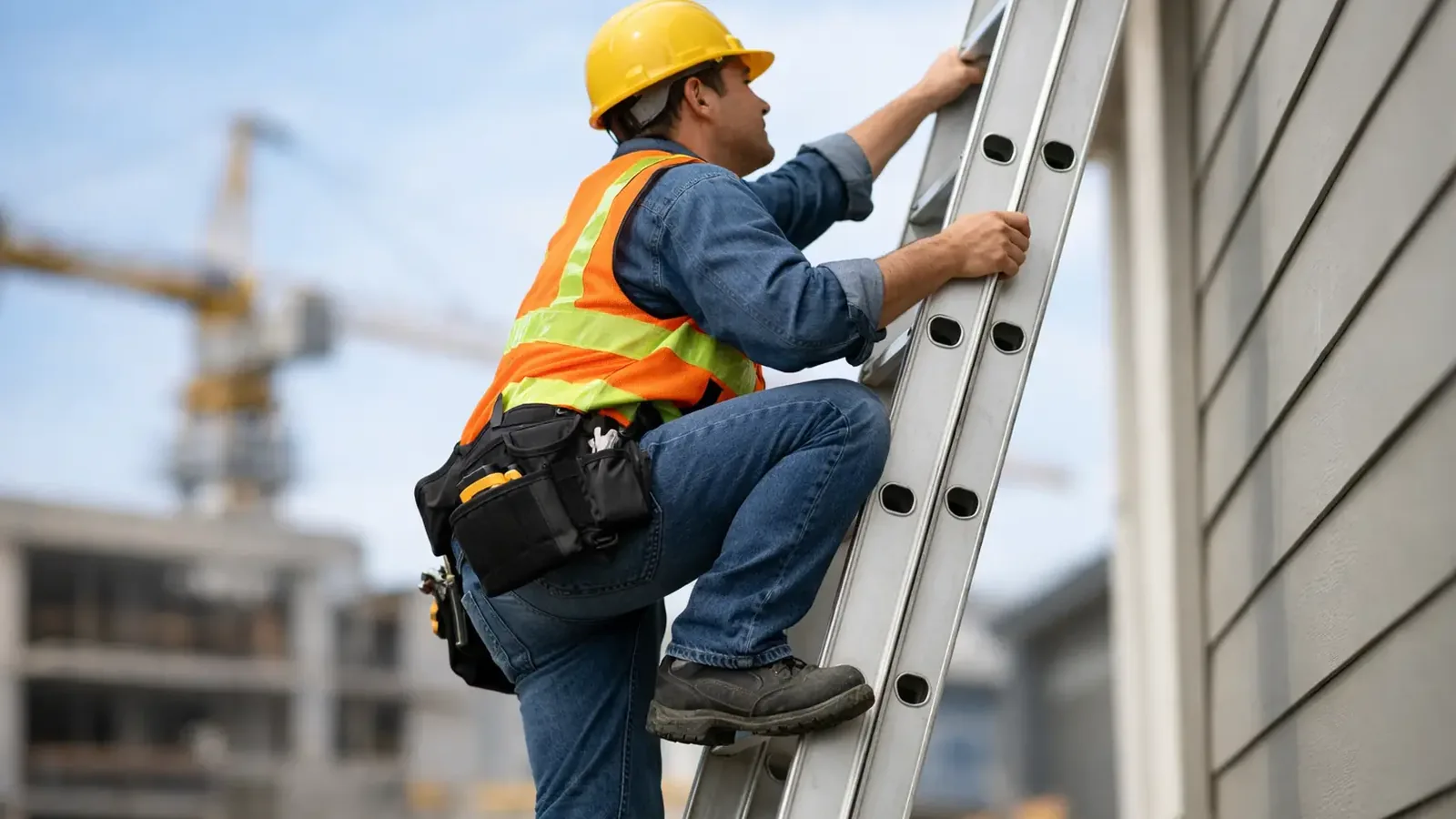
A worker is halfway up an extension ladder with a drill in one hand and a box of fasteners hooked over the other arm. The ladder shifts just enough to make the next step feel wrong. That is where three point contact ladder safety stops being a poster phrase and becomes a decision: put the tools down, climb down, and fix the setup. A job delayed for two minutes beats a fall that changes somebody's life.
What three point contact actually means
Three-point contact means keeping three of four possible contact points on the ladder while climbing: two feet and one hand, or two hands and one foot. In real work, the normal position is both feet on the rungs and one hand gripping the ladder. Your body stays facing the ladder, close enough that you are not reaching backward or twisting around.
The rule is simple because climbing is not the time to carry, pull, text, or improvise. A hand that is holding a drill, paint can, bundle of conduit, or a phone is not available to catch a shift. A hand resting against a wall is not gripping the ladder. And a boot perched on the edge of a rung is not secure contact.
OSHA's ladder rules require employees to use at least one hand to grasp the ladder when climbing up or down. That is the regulatory floor. Three-point contact is the practical way workers apply that requirement and reduce the chance that a slip becomes a fall.
The rule does not fix a bad ladder setup
Three-point contact ladder safety matters, but it cannot rescue a ladder that was placed on loose gravel, leaned at the wrong angle, or set in a forklift travel lane. Workers sometimes treat hand contact as the whole program: grab a rung, climb carefully, hope for the best. That misses the controls that need to be in place before the first boot leaves the ground.
Start with the ladder itself. It needs to be the right type and duty rating for the task, free of cracks, bent rails, damaged rungs, missing feet, loose hardware, oil, mud, and unauthorized repairs. A ladder tagged out of service is not a challenge to see whether it will hold one more time. It is out of service.
Then look at the ground and the route above. Both feet must sit on a firm, level surface. Do not shim a ladder with scraps, blocks, pallets, or a piece of steel plate. Keep it out of doorways unless the door is locked, blocked, or guarded. Keep it away from moving equipment and overhead electrical hazards. A metal ladder near energized parts is a bad gamble; a wet fiberglass ladder can also lose the insulating properties workers assume it has.
For a non-self-supporting extension ladder, use the 4-to-1 setup rule. Place the base one foot out from the supporting surface for every four feet of working length to the upper support. A ladder with a 20-foot working length needs its base about five feet out. Too steep and it can tip backward. Too shallow and the base can kick out.
Secure the ladder at the top when possible. If it cannot be secured there, stabilize it at the base and have a second person hold it while the climber secures it. That second person is not a permanent substitute for tying off or securing the ladder. They are there to control the hazard during setup, not to stand underneath all day hoping nothing moves.
Landing access needs more than a rung
When an extension ladder is used to reach an upper landing, the side rails generally need to extend at least three feet above that landing, or the worker needs equivalent secure handholds. That extra length gives the climber something solid to hold while stepping on or off. Stepping sideways from a ladder onto a roof edge, platform, or mezzanine with nothing to grab is where balance disappears fast.
If the ladder cannot be positioned for a safe transition, it is the wrong access method. Use a different ladder, scaffold, stair tower, aerial lift, or another approved approach. Production pressure does not make an awkward transfer safe.
Hands are for climbing, not hauling
A frequent three-point-contact failure is easy to recognize: someone carries the work up the ladder. It may be a cordless drill, a bucket, a coil of wire, a socket set, or one piece of material that is supposedly light enough. The weight is not the only problem. It shifts the worker's center of gravity, occupies a hand, and encourages reaching.
Get tools and material to the work area another way. Use a tool belt or backpack that does not interfere with climbing, a hand line after you are positioned, a material hoist, or a coworker working from a safe location. Inspect bags, belts, and hand lines too. A swinging load can strike someone below or pull a worker off balance.
Do not climb while wearing footwear with mud, grease, snow, or wet paint on the soles. Clean the soles first. The same goes for gloves coated with oil or product. Three points of contact on slippery surfaces are still slippery surfaces.
Face the ladder and stay between the rails
Climb and descend facing the ladder. Keep your belt buckle between the side rails. That phrase is worth remembering because it exposes overreaching immediately. If your buckle moves past a rail to reach a corner, pipe, fixture, or panel, climb down and reposition the ladder.
Never move or "walk" a ladder while standing on it. Never slide it sideways from the roof or platform. Never ask a coworker to shove the base a few inches while you stay up top. The ladder may move only a few inches. Your body may travel much farther.
The top cap of a stepladder is not a step unless the ladder was specifically designed and labeled for that use. Neither is the pail shelf, rear bracing, or the back side of a single-sided stepladder. A stepladder must be fully open with spreaders locked, not leaned against a wall like a straight ladder.
When three points are not enough
There are tasks where a ladder is technically available but operationally wrong. If you need both hands to drill overhead, pull cable, operate a heavy tool, install large material, or work sideways for more than a moment, a ladder may not give you a stable working position. Three-point contact applies while climbing. It does not mean you can perform a two-handed task from a ladder after making a shaky transition.
This is where supervisors need to stop treating ladders as the default answer to every elevated task. A scaffold or aerial lift may take longer to bring in, but it can give the worker a platform, guardrails, a safer work position, and room for materials. The right choice depends on height, duration, access, tool force, overhead hazards, ground conditions, and whether the task requires both hands.
Fall protection requirements also depend on the work setting and equipment involved. In construction, fall-protection rules often apply at six feet or more, with specific requirements based on the activity and surface. A ladder is not a loophole around fall protection. If the job requires a personal fall arrest system, workers need the right anchorage, equipment, inspection, and training. A harness in the truck does nothing for the person on the edge.
What supervisors should correct on the spot
A good correction is specific. "Be careful" is not instruction. Say what is wrong and what changes before work resumes: secure the top, reset the angle, clear the travel path, bring up a hand line, clean the boots, or use a lift instead.
Watch for these conditions during a quick field check:
- A worker carrying anything that prevents a firm hand grip.
- A ladder base sitting on debris, uneven ground, grating, or a slippery surface.
- A climber reaching outside the rails instead of repositioning.
- A stepladder being used folded, leaned, or from the top cap.
- An extension ladder without proper upper support, securement, or enough rail above the landing.
- A ladder set near electrical exposure, swing doors, vehicle traffic, or active overhead work.
Training should include a live demonstration, not just a signature sheet. Workers need to show they can inspect, carry, set, secure, climb, reposition, and remove a ladder under the conditions they actually face. OSHA outreach cards and online courses can build awareness, but they do not replace employer-provided, site-specific training and supervision.
The next time the job calls for a ladder, slow down before the climb. Set it right. Secure it. Keep a hand on it. If the work will not let you do that, the answer is not to take a chance. The answer is to change the equipment before the equipment changes somebody's life.