Blog · Ladders and fall protection
Ladder 4 to 1 Rule for Safe Setup Before Climbing
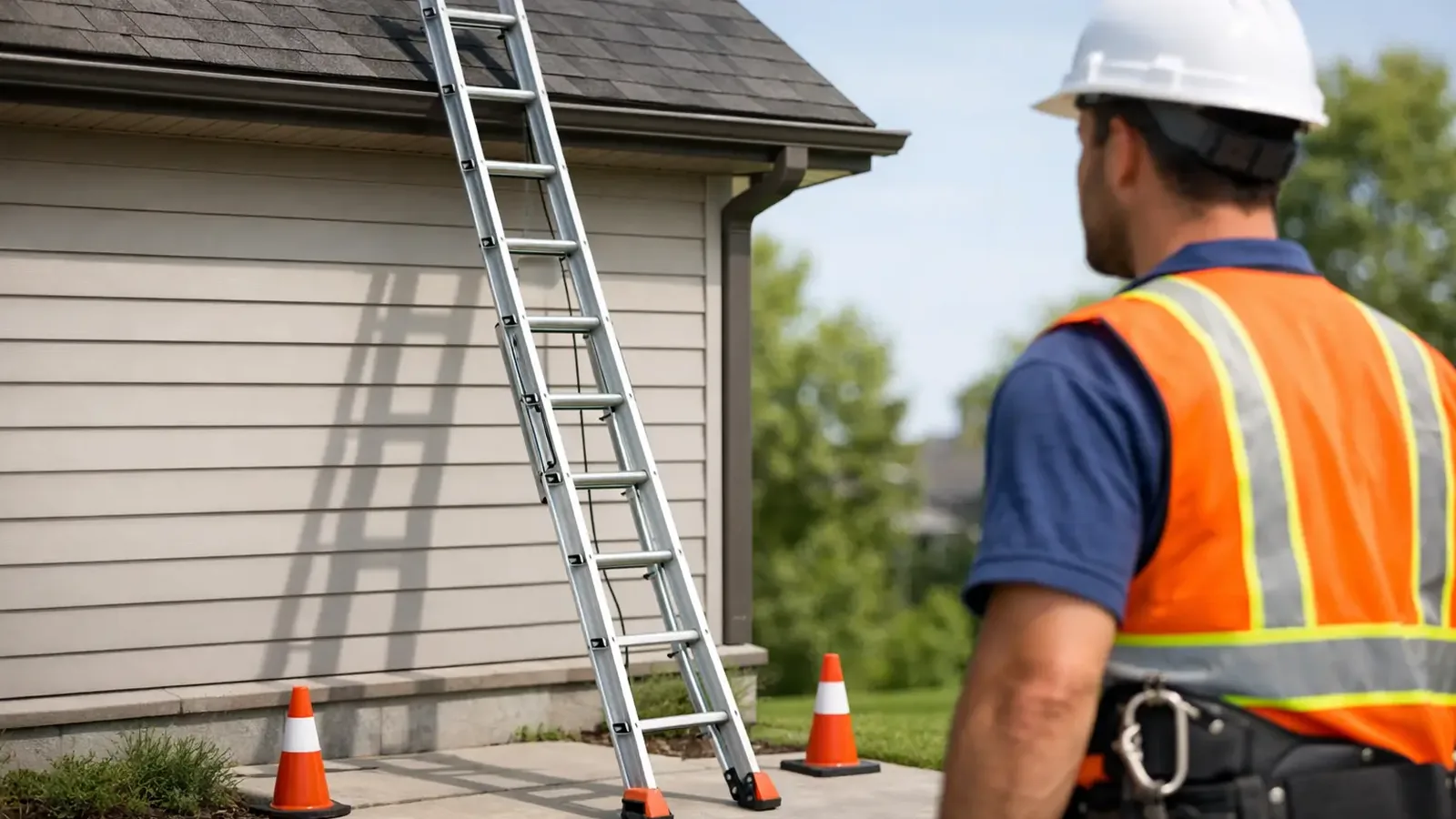
A ladder is not safe because it looks steep enough, feels stable for the first rung, or has been used that way a hundred times. The ladder 4 to 1 rule gives workers a fast way to set a straight or extension ladder at an angle that is far less likely to slide out, tip, or put damaging stress on the rails.
The rule takes seconds. The fall can change a life before lunch.
What the ladder 4 to 1 rule means
For every 4 feet of vertical working length, place the ladder’s feet 1 foot away from the structure. Working length is the distance from the ground at the ladder’s base to the upper support point, not the overall ladder length printed on the rail.
If the ladder contacts a wall, roof edge, or other upper support 16 feet above the ground, its base belongs 4 feet out. At a 20-foot support point, the base should be 5 feet out. OSHA requires a non-self-supporting portable ladder to be placed so the horizontal distance from the top support to the foot is about one-quarter of the working length, a 1:4 ratio (29 CFR 1926.1053(b)(5)(i)). The resulting angle is approximately 75 degrees.
This applies to straight ladders and extension ladders that lean against a structure. It does not mean every ladder gets shoved out one foot from the wall. A step ladder is self-supporting and must be fully opened with its spreaders locked. A fixed ladder has separate design and fall-protection requirements. Do not force a rule from one ladder type onto another.
Why the angle matters on a real job
Set the base too close, and the ladder becomes nearly vertical. It can tip backward when a worker shifts weight, carries a tool, or steps off at the top. The worker may also have to lean backward to climb, which puts their center of gravity in the wrong place.
Set it too far out, and the ladder is too flat. The rails take more bending force, the feet are more likely to kick out, and the top can slide down the support. A ladder that looks comfortably laid back is not forgiving. It is loaded wrong.
The 4-to-1 setup is not a magic shield against a fall. It is one control in a system that includes a sound ladder, solid support, secure footing, three-point contact, and a worker who does not overreach. But it removes a frequent setup error: guessing the angle because production is moving.
How to measure it without turning setup into paperwork
You do not need a tape measure for every climb if you can make a reasonable field measurement. First, identify where the ladder will rest at the top. Measure or estimate the vertical distance from that point to the ground. Divide that distance by four. That is how far the feet should sit away from the structure.
For example, a team needs access to a roof edge 24 feet above grade. Twenty-four divided by four equals six. Set the ladder base 6 feet away from the wall or roofline support.
A quick body-based check can help when a measurement is not practical. Stand with your toes at the ladder feet, face the ladder, and extend your arms straight ahead at shoulder height. You should be able to grasp a rung around shoulder level. This is a rough field check, not a reason to ignore an obvious bad angle or a measured site plan.
The rule gets harder when the ground slopes, the surface is uneven, or the upper contact point is not directly above a clear landing area. That is not a reason to “make it work.” It is a reason to change the setup. Reposition the work, level the base using an approved ladder leveler, use a different access method, or bring in a lift or scaffold when the task calls for it.
The base and top both need to hold
A correctly angled ladder can still fail if it is sitting on loose gravel, oily concrete, cardboard, a pallet, or a sheet of plywood laid over a hole. Ladder feet need firm, level, non-slippery support. Never level a ladder by placing blocks, bricks, buckets, or scrap lumber under one rail. Those improvised fixes are how a simple climb becomes a broken ankle, head injury, or worse.
At the top, both rails need solid, even contact with a support that can take the load. Do not rest a ladder on a window sash, conduit, a guardrail, plastic gutter, loose siding, or a narrow pipe. If the contact surface is questionable, it is not a support point.
Secure the ladder at the top whenever practical. If tying it off is not feasible during setup, secure the base against movement or have another worker hold it while the ladder is being tied. A coworker standing at the bottom is temporary help, not a replacement for securing the ladder for the job.
Watch the area around the base too. A ladder set in front of an active doorway, vehicle lane, or forklift route needs protection. Move it, barricade the area, lock the door if it does not create another hazard, or assign control of the traffic. “Everybody knows it’s there” is not a control.
Accessing an upper level? Give yourself enough ladder
When a portable ladder provides access to an upper landing, roof, platform, or similar level, the side rails generally need to extend at least 3 feet above that landing surface. The extra rail gives workers something to hold while stepping on or off. Grabbing the top rung, a roof edge, or whatever is nearby is not the same thing.
This is where workers sometimes create two problems at once. They use a ladder that is too short, then compensate by standing high on the rungs or setting it too steep to reach. Neither shortcut fixes the issue. Get a ladder long enough for the work and set it at the proper angle.
Extension ladders also need adequate overlap between sections, based on the ladder’s length and manufacturer instructions. The fly section must be properly engaged on its rung locks. A ladder extended to its limit with barely any overlap is not ready because it technically reaches.
Common 4-to-1 rule mistakes
One mistake is measuring from the wrong point. Workers may use the ladder’s full length, even though several feet extend above the roof edge. The calculation is based on the vertical distance to the upper support point. If the ladder is being used for roof access, calculate to the roof edge where the ladder bears, then make sure the rails continue at least 3 feet above it.
Another mistake is treating the rule as the only check. A ladder can be at the right angle and still be defective. Before use, inspect rails, rungs, feet, rung locks, rope and pulley assemblies, spreaders, labels, and hardware. Remove a damaged ladder from service. Bent rails, cracked fiberglass, missing feet, and improvised repairs are not minor defects.
Workers also get hurt by working sideways from a properly placed ladder. Keep your belt buckle between the rails. If you have to reach, twist, or pull hard to get the job done, climb down and move the ladder. It takes less time than explaining why the ladder walked out from under you.
Finally, do not confuse a ladder safety talk, OSHA 10 card, or online course completion certificate with job-ready authorization. Those can provide useful awareness, but the employer still has to provide training and ensure workers understand the ladder hazards and procedures at the site. OSHA’s portable ladder requirements appear in 29 CFR 1926.1053 for construction and 29 CFR 1910.23 for general industry. The standard sets the floor. Your job conditions may require more.
When the 4-to-1 rule is not enough
Some jobs should not be done from a leaning ladder at all. Long-duration work, heavy drilling, forceful pulling, handling bulky material, repeated trips, electrical exposure, or work where both hands are needed may call for a scaffold, aerial lift, platform ladder, or another access method.
A ladder is access equipment first. It is a poor substitute for a work platform when the task demands leverage, room to move, or prolonged hands-on work. The right question is not, “Can I reach it from this ladder?” Ask, “Can I do this task without fighting the ladder the entire time?”
Before the next climb, take the few seconds to check the angle, the ground, the top contact, and the route around the base. The job can wait for a ladder that is set right. Your body should not be the thing that tests whether it was close enough.