Blog · Ladders and fall protection
Construction Guardrail Requirements That Stop Falls
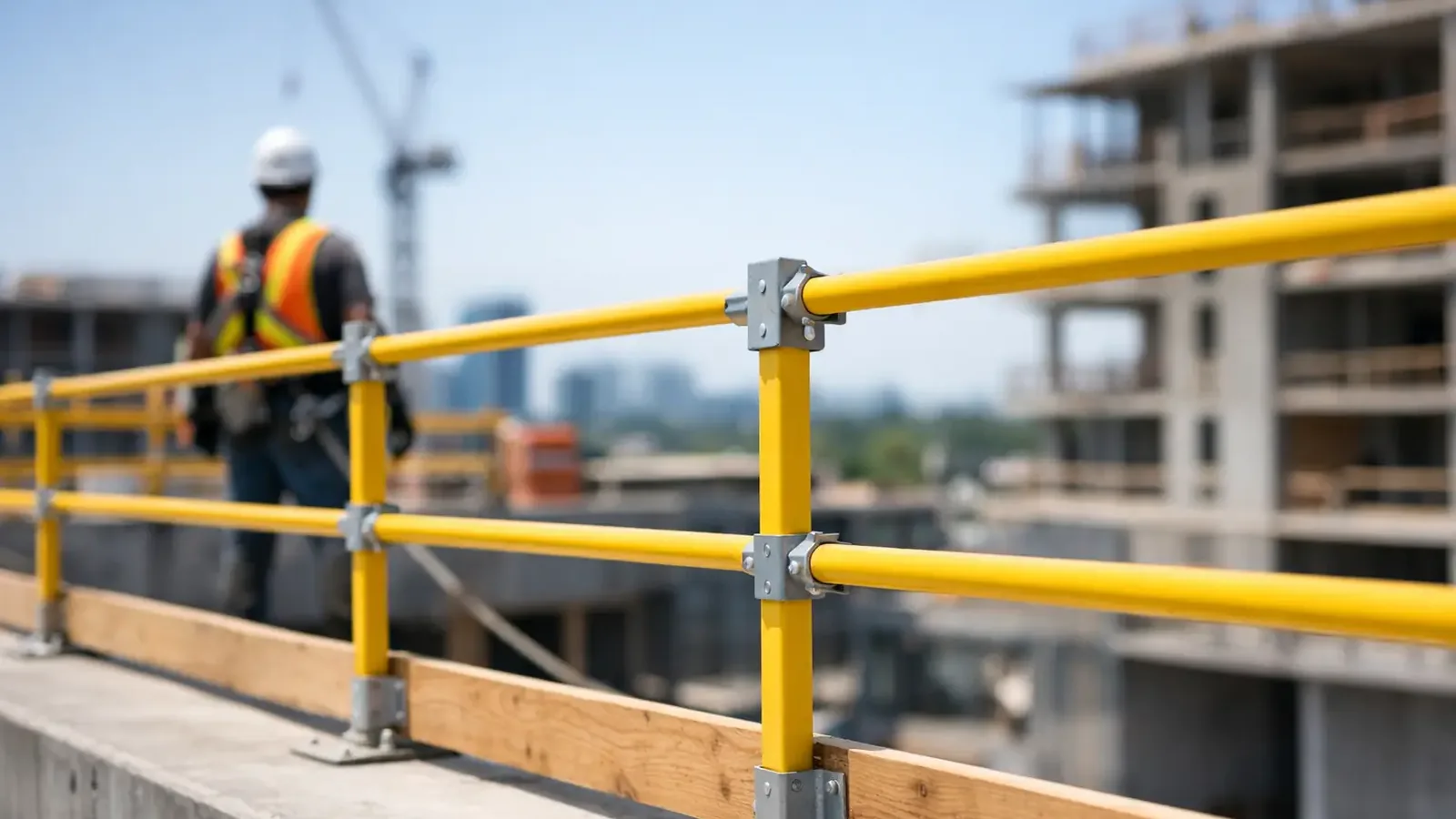
A missing rail is rarely a mystery. Somebody removed it to land material, left an opening for access, or assumed workers would stay clear of the edge. Then the work shifts, someone backs up while carrying lumber, and an unprotected side becomes a fall. Construction guardrail requirements exist for that exact moment - when production is moving and nobody has a free hand to save themselves.
A guardrail is not a suggestion, caution tape, or a 2x4 laid across an opening. It is a fall-protection system with specific construction, strength, and placement requirements. If the rail cannot stop a worker from going over the edge, it is not doing its job.
When construction guardrail requirements apply
Under OSHA construction rules, fall protection is generally required when workers are exposed to falls of 6 feet or more. On many jobs, a compliant guardrail system is one acceptable way to provide that protection. Depending on the task, OSHA may also allow a personal fall arrest system, safety net, or another specifically permitted method.
That word, "may," matters. Guardrails are not automatically the answer to every elevated-work problem. They are often the most practical answer for a fixed edge, floor opening, ramp, runway, or platform where people need to work repeatedly. A rail protects everyone in the area without requiring each person to hook up every time they approach the hazard.
Common situations that call for guardrail protection include open-sided floors, roofs and leading edges, elevated platforms, floor holes, wall openings, ramps, runways, and certain excavation edges. OSHA's general construction fall-protection rule is 29 CFR 1926.501. The detailed guardrail criteria are in 29 CFR 1926.502(b).
The exact rule depends on the exposure. For example, a floor hole can be protected with a secured cover, a guardrail system, or personal fall arrest equipment when the fall distance is 6 feet or more. An open-sided floor may need a guardrail along the exposed edge. A leading edge can involve different options and limited exceptions based on whether conventional protection is feasible and whether a properly developed fall-protection plan applies.
Do not turn the 6-foot rule into an excuse to ignore a 5-foot fall. A shorter fall can still put a worker onto rebar, machinery, forms, debris, or a lower-level obstruction. OSHA's minimum threshold is not a promise that anything below it is harmless. The employer still has a duty to address recognized hazards.
What a compliant guardrail system looks like
The top rail must be 42 inches above the walking or working surface, plus or minus 3 inches. In plain terms, the top edge should land between 39 and 45 inches high. That height is not random. A knee-high rail may slow someone down, but it will not reliably stop a worker who stumbles, slips, or gets bumped while handling material.
A midrail must be installed about halfway between the top rail and the working surface when there is no other intermediate protection. Screens, mesh, balusters, or other intermediate members can also close that space if they meet OSHA's criteria. The point is simple: the opening below the top rail cannot be large enough to let a worker slide or fall between the rails.
The top rail must withstand at least 200 pounds of force applied within 2 inches of the top edge in an outward or downward direction. Midrails, screens, mesh, and other intermediate members must withstand at least 150 pounds of force. A rail made from loose lumber, light-gauge material, or a single improvised clamp may look fine from ten feet away. It may also fold the first time somebody leans into it.
Rail surfaces must be smooth enough to prevent punctures, lacerations, and clothing snags. Posts, braces, bolts, and cut metal should not create a catch point. If wire rope is used, it must be flagged at intervals of no more than 6 feet with highly visible material. A wire rope at shin height that blends into the work area is a trip hazard pretending to be fall protection.
Guardrails are not handrails
Workers often use these words interchangeably, but the equipment serves different purposes. A handrail gives a person something to hold while using stairs. A guardrail protects a person from falling off an elevated edge. A stair rail may perform both functions only if it meets the applicable requirements.
Stairways with four or more risers, or a rise greater than 30 inches, have their own OSHA stairway requirements under 29 CFR 1926.1052. Do not assume a temporary stair rail meets the guardrail rules just because it is made from the same lumber. Check its height, intermediate protection, strength, and the specific stair configuration.
The jobsite mistakes that defeat a good rail
The biggest guardrail failures usually happen after installation. A contractor builds a solid perimeter rail, then removes a section to fly in material or pass sheets of plywood. The opening stays open because the lift is "almost done." That is when another trade walks into the area and steps backward through the gap.
If a section must come out for access, the exposure needs active control. Reinstall the rail immediately when the task is complete. If the opening remains necessary, use a gate or another compliant method that protects workers at the edge. A chain, caution tape, or verbal warning is not a guardrail system.
Material storage creates another common problem. Bundles of framing, roofing stock, or pipe get stacked against a rail. The material can overload or push on the system, reduce the usable work area, and encourage workers to climb or reach over the top rail. Keep stock away from the edge and make sure the rail has not been bent, loosened, or buried behind material.
Weather also changes the calculation. Wind can loosen temporary rail components. Ice, mud, and wet decking increase the chance that a worker will hit the rail hard. On a slick surface, a rail needs to be more than present. It needs to be anchored, complete, and capable of taking the load.
Openings, leading edges, and changing work
A guardrail around an opening needs to stay complete on all exposed sides. It is not enough to rail three sides and tell workers to watch the fourth. If access is required through the protected area, plan the access point instead of creating an unprotected hole in the protection.
Leading-edge work deserves special attention because the edge moves as the work progresses. Steel erection, deck installation, roof sheathing, and precast work can change the exposure by the hour. The rail layout has to move with the job, and workers need to know where the protected boundary ends. A rail that protected yesterday's edge may be irrelevant after today's deck extension.
Some construction activities have specialized OSHA provisions, and certain circumstances may permit alternatives to conventional fall protection. That does not mean a supervisor can simply call an edge "controlled" and keep working. Where a controlled access zone or fall-protection plan is allowed, it has defined conditions and is not a shortcut for missing equipment or poor planning.
Who is responsible for inspection and correction?
The employer is responsible for providing fall protection, selecting systems that meet the standard, training workers on the hazards, and correcting damaged or incomplete protection. An OSHA 10 card, online course completion record, or a worker's past experience does not transfer that responsibility to the employee.
Workers still have a direct role. Before starting near an edge, look at the rail like your next step depends on it - because it may. Check four things:
- The top rail is at the proper height and the midrail or intermediate protection is in place.
- Posts, connections, and anchors are secure, with no obvious bending, splitting, or looseness.
- No section has been removed for material access, equipment movement, or another contractor's work.
- The area behind the rail is clear enough that nobody has to climb, lean, or reach over it to do the task.
If something is wrong, stop using that edge as if it is protected. Tell the supervisor or competent person immediately and keep people away until it is corrected. Do not repair a questionable rail by tying on scrap wood or adding tape. Temporary does not mean weak, and a quick fix can create false confidence.
A good guardrail lets workers focus on the work instead of gambling on balance. Before the shift gets moving, walk the edges, find the gaps, and fix them while the correction is still easy.