Blog · Lockout/tagout · 29 CFR 1910.147
Temporary Removal of Lockout Tagout Rules
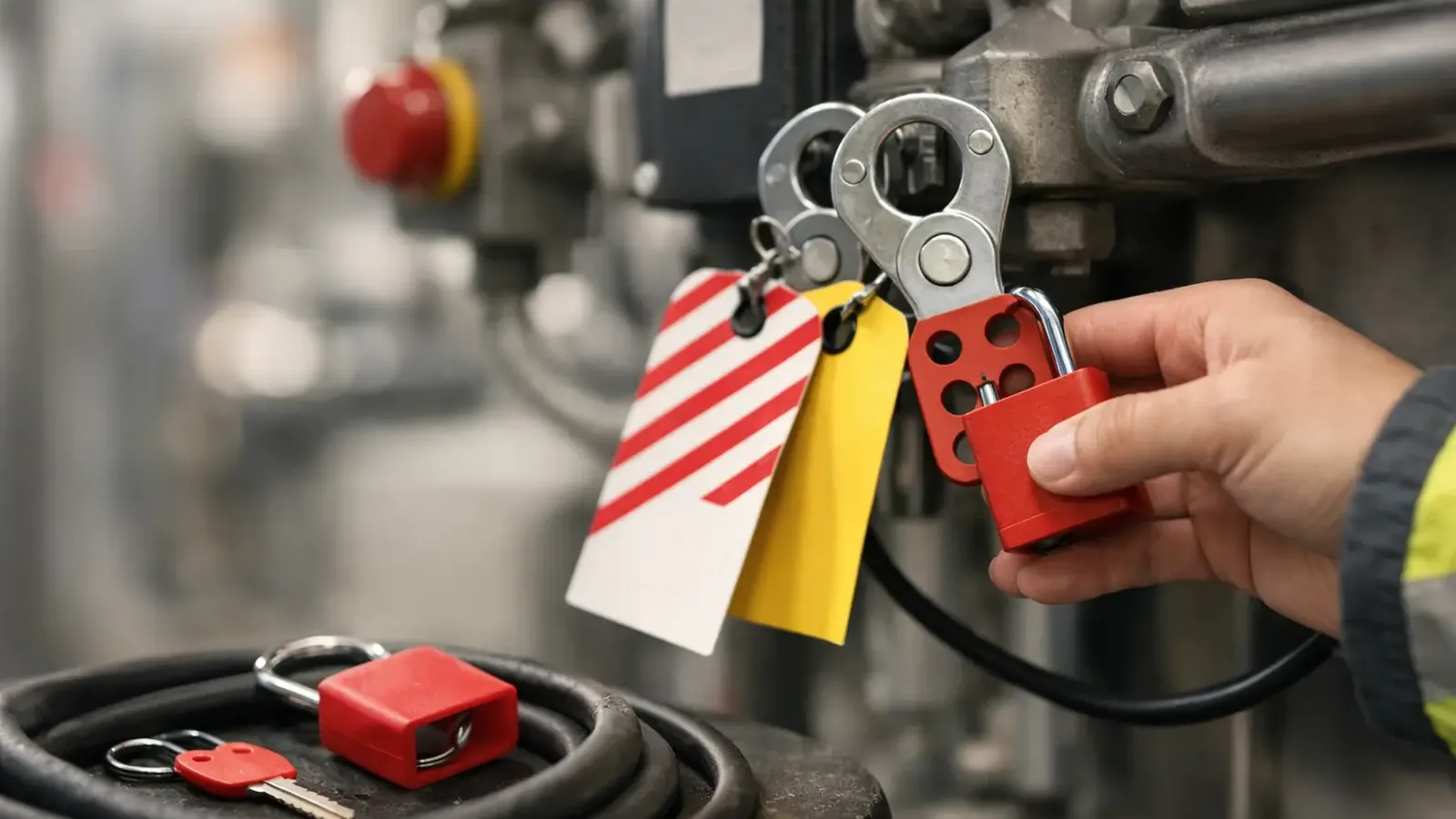
A machine is locked out, the repair is nearly finished, and somebody says, “We just need to bump it.” That is the moment temporary removal of lockout tagout becomes a life-or-death decision, not a paperwork issue. A lock and tag cannot come off because the line is behind schedule, a supervisor wants a test run, or the next shift is waiting.
OSHA does allow lockout/tagout devices to be removed temporarily in limited situations. But the rule is not “take it off, test it, and put it back on.” The equipment must move through a controlled sequence that protects everyone exposed to hazardous energy. Skip a step and the person inside the machine, at the coupling, or working downstream may be the one who pays for it.
When Temporary Removal of Lockout Tagout Is Allowed
Under OSHA's control of hazardous energy standard, 29 CFR 1910.147, temporary removal may be necessary when equipment must be energized for testing, positioning, or adjustment. Think of a conveyor that must be jogged to align a belt, a press that needs a controlled movement to verify a repair, or a machine that must cycle to diagnose an electrical fault.
That is different from restarting production because workers are tired of waiting. It is also different from removing another worker's lock because that worker went home. Each situation has its own requirements, and both demand a written employer procedure.
For testing or positioning, OSHA requires the employer to follow a specific sequence. The point is simple: before energy comes back on, make sure nobody is still in harm's way and that the machine is ready to run.
The authorized employee must first clear the machine or equipment of tools and materials. Next, employees must be removed from the area. The authorized employee then removes the lockout or tagout devices according to the established procedure and energizes the equipment for the test or positioning task. Once the test is complete, the equipment must be deenergized again and lockout/tagout controls reapplied before servicing resumes.
That sequence matters. A wrench left in a guard, a worker still behind a machine, or a mechanic who believes the disconnect remains locked can turn a brief test into a catastrophic startup.
A “Quick Bump” Is Still Energization
Calling it a bump, jog, inch, spin, or quick check does not change the hazard. If the machine can move, rotate, drop, release pressure, heat up, or deliver electrical energy, it is energized work.
Employees need to know exactly what will happen, who will operate the controls, where people must stand, and what energy sources are being restored. On complicated equipment, a test may involve more than the main electrical disconnect. Hydraulic accumulators, pneumatic lines, gravity, springs, steam, process chemicals, and stored mechanical energy can all create exposure.
A good temporary energization plan answers practical questions before anyone touches a lock: Can someone account for every person? Are guards or covers required for the test? Does anyone need to be outside the danger zone? Can the test be performed using a safer method, such as remote controls, a diagnostic port, or a reduced-energy setup?
“It will only move an inch” is not a control measure. An inch is enough to crush a hand, pull in a sleeve, or shift a suspended load.
The lock owner normally removes the lock
The basic rule is straightforward: each lockout or tagout device is removed by the authorized employee who applied it. That personal control is the backbone of lockout/tagout. A worker should never arrive at a machine, see their lock gone, and learn later that someone decided the work was finished.
There is a narrow exception when the authorized employee is not available. OSHA permits an employer to remove that employee's device only under a specific documented procedure and only when the employer can show that the procedure provides equivalent protection.
At a minimum, that procedure must verify that the authorized employee is not at the facility, make all reasonable efforts to contact that employee, and ensure the employee knows their device was removed before they resume work at the facility. A supervisor saying, “He probably left,” does not meet that standard.
This is why a master key is not a shortcut around the rule. A master key may be part of a carefully controlled employer procedure, but it is not permission for whoever has access to clear locks and start equipment.
Shift Changes Need a Real Handoff
Temporary removal is often confused with lockout transfer during a shift change. They are not the same thing. If servicing continues into the next shift, the energy-control protection must continue without a gap.
The outgoing authorized employee should communicate the equipment status, work completed, hazards remaining, and energy-isolation points to the incoming authorized employee. The incoming worker applies their lock before the outgoing worker removes theirs. Group lock boxes, hasps, and written turnover procedures can make this manageable, but the goal stays the same: no moment exists when the machine is unprotected while someone may still be exposed.
The dangerous version sounds familiar: “Night shift can finish it. I took my locks off already.” If the equipment is not fully released for service and every affected worker has not been notified, that is not a handoff. It is an uncontrolled restart waiting to happen.
Notification Is Part of the Control
Before lockout/tagout devices are removed and equipment is energized, affected employees must be notified. These are the operators, helpers, material handlers, and others who use the machine or work nearby but may not perform the servicing themselves.
They need more than a vague announcement that maintenance is “wrapping up.” Tell them the equipment is being tested or returned to service, what area is off limits, and when normal operation is expected. In a noisy plant, a radio call alone may not be enough. The method has to work where the work is happening.
Notification protects against another common failure: an operator walks up, assumes the repair is complete, and starts a machine while a technician is still resetting guards or checking the result of a test.
Who Is Allowed to Make the Call?
Only authorized employees perform lockout/tagout, and the employer must train them on the recognition of hazardous energy sources, the type and magnitude of energy available, and the methods for isolation and control. Being experienced around equipment does not automatically make someone authorized.
Supervisors also need to understand the boundary. They can coordinate work, but they cannot replace the employer's energy-control procedure with a verbal instruction. If the written procedure does not address the equipment, the testing method, group lockout, or off-shift lock removal, stop and get the process clarified before energizing.
This is especially important with contractors. When contractor employees and host employees work on the same equipment, both employers must exchange lockout/tagout information. Everyone needs to know whose locks are on, how group protection works, who controls testing, and how the equipment will be released. Different colored locks do not solve a communication failure.
Use a Release-to-Service Check, Not a Guess
Before the final restart, the authorized employee should inspect the work area and confirm the machine is operationally intact. Tools, parts, blocks, jumpers, and temporary guards need attention. So do people. Every employee must be safely positioned or clear before the devices come off.
Then notify affected employees that servicing is complete and the equipment is being returned to service. Remove locks and tags only through the established procedure. Restart in a controlled way, watching for unexpected movement, leaks, abnormal sounds, or failed safeguards.
The exact details depend on the machine and the job. A simple motor test is not the same as bringing a complex production cell, hydraulic press, or energized electrical system back online. But production pressure never changes the central rule: hazardous energy is controlled until the people exposed to it are clear and the equipment is ready.
A lockout device is not a bookmark you pull out when the work gets inconvenient. If a test requires power, plan the test, clear the people, control the restart, and lock it back out before the work continues.