Blog · Lockout/tagout · 29 CFR 1910.147
When Is Lockout Tagout Required During Maintenance?
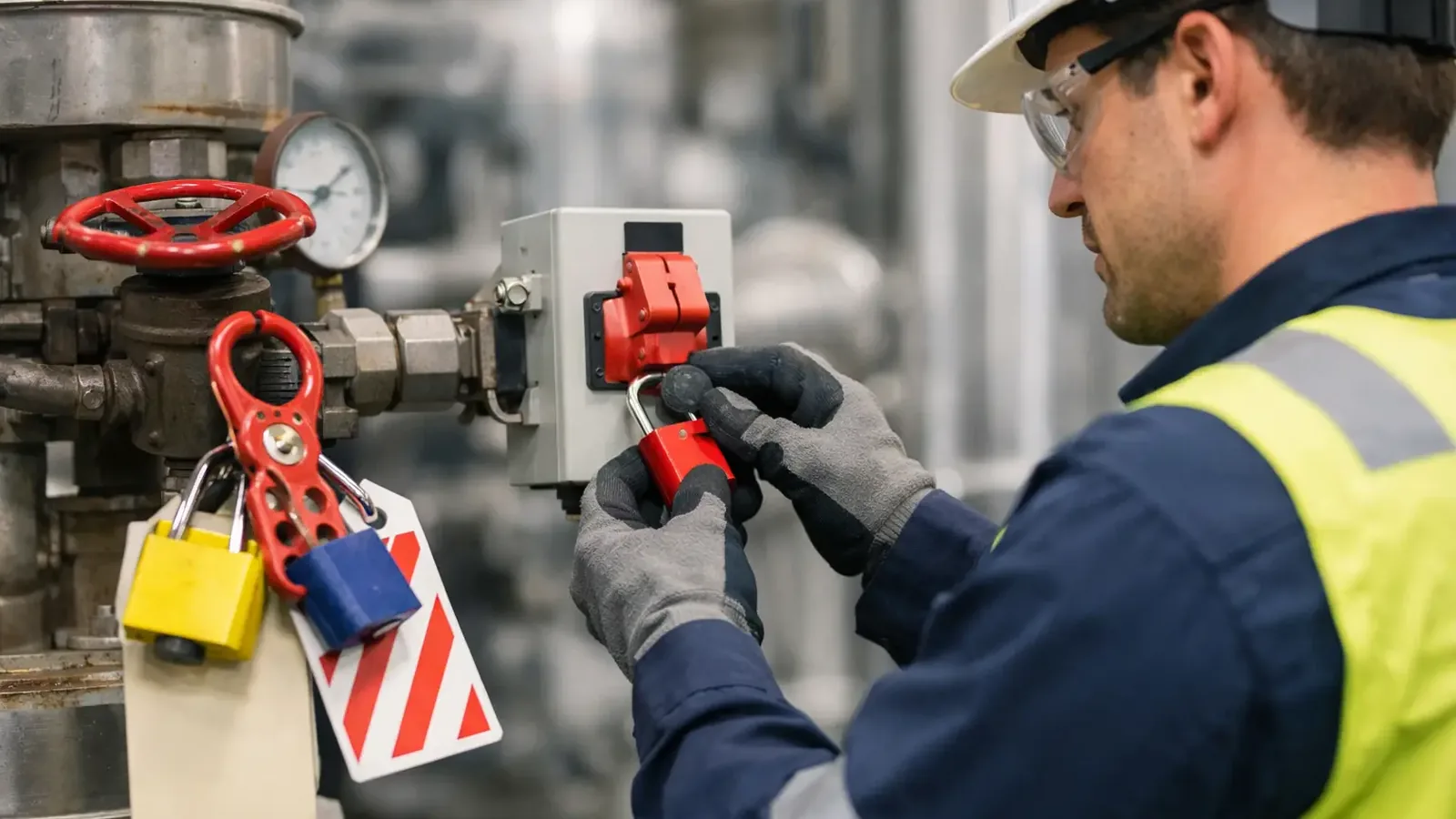
A jammed conveyor, a guard that needs straightening, a sensor that is “just getting adjusted” - those are the moments when people gamble with energy control. The question is when is lockout tagout required? The plain answer: before servicing or maintenance exposes a worker to unexpected startup, energization, or release of stored energy that could cause injury.
That is not paperwork. It is the difference between a machine staying dead and someone hearing, too late, “I thought it was locked out.”
When Is Lockout Tagout Required?
Under OSHA’s general industry lockout/tagout standard, 29 CFR 1910.147, lockout/tagout is required when an employee performs servicing or maintenance on a machine or piece of equipment and could be exposed to hazardous energy.
Hazardous energy is more than electricity. It includes mechanical movement, hydraulic pressure, pneumatic pressure, gravity, steam, chemicals, heat, and any stored or residual energy. A hydraulic cylinder can drift. A raised platen can fall. A compressed-air line can move a ram. A conveyor can restart from a control station nobody checked.
The key question is not, “Is the machine turned off?” The key question is, “Could this worker be hurt if this equipment starts, moves, releases pressure, or receives energy while the work is being done?” If the answer is yes, energy control is required.
Turning off a control switch is not lockout. Pressing an emergency stop is not lockout. Pulling a fuse without controlling access is not lockout. Those actions may stop the machine for the moment, but they do not prevent another person, an automatic cycle, or stored energy from bringing the hazard back.
Servicing Means More Than Repairing a Broken Machine
Workers sometimes picture lockout/tagout as something for major repairs: replacing a motor, rebuilding a press, or working inside a mixer. Those jobs clearly require it. But OSHA’s definition of servicing and maintenance is wider than that.
It can include setting up, adjusting, inspecting, modifying, lubricating, cleaning, unjamming, installing, constructing, or maintaining equipment. If the task puts hands, arms, bodies, tools, or clothing into a danger zone, treat it seriously.
Consider a few ordinary shift problems. A warehouse mechanic reaches into a stretch-wrapper to clear film from a rotating carriage. A production worker opens a guard to realign a photo eye. A fabricator cleans metal chips from a machine area after the cycle has stopped. A maintenance tech checks a chain drive behind a removable panel. Each task may expose someone to motion or energy that was supposed to be stopped.
The job may take two minutes. The injury can last a lifetime. Short duration does not create a lockout/tagout exemption.
Normal Production Is Not a Free Pass
Normal production operations are the routine use of a machine to perform its intended production function. OSHA generally does not apply the lockout/tagout standard to workers operating equipment during normal production if they are protected by properly designed machine guarding and other effective controls.
That boundary matters. Running a press from its normal controls with guards in place is production. Reaching past or removing the guard to clear a jam is servicing. Once the task exposes a worker to hazardous energy, the conversation changes.
There is a narrow exception for minor tool changes, adjustments, and other minor servicing activities performed during normal production. The work must be routine, repetitive, and integral to using the equipment for production. The employer must also use alternative measures that provide effective protection.
All of those conditions matter. “We do it all the time” does not prove the exception applies. In fact, it may prove the opposite: a repeated exposure deserves a real engineered control, not a team habit built around luck.
An alternative protective measure might involve a properly designed interlock, remote adjustment device, presence-sensing safeguard, or another method that keeps the employee out of the hazard zone. A supervisor standing nearby, a verbal warning, or faith that nobody will hit the start button are not effective alternative protection.
The Cord-and-Plug Exception Has a Hard Boundary
Some portable, cord-connected equipment can be serviced without a formal lockout device if it is unplugged from its energy source and the plug remains under the exclusive control of the employee doing the work.
For example, a worker changing a blade on an unplugged portable saw may use this exception if that worker keeps control of the plug throughout the job. If the plug is across the room, behind equipment, or available for someone else to reconnect, it is not under exclusive control.
This exception does not apply just because equipment has a cord. If there are other energy sources, stored energy, or a plug that cannot stay under the worker’s control, use a proper energy-control procedure.
What Proper Lockout Actually Looks Like
A lockout is a sequence, not a padlock clipped onto a disconnect. The employer’s energy-control procedure should identify the equipment, all energy sources, shutdown steps, isolation points, lockout devices, stored-energy controls, verification steps, and restart steps.
In the field, the basic sequence is straightforward:
- Notify affected employees that the equipment will be shut down and locked out.
- Shut down the machine using normal operating controls.
- Isolate every energy source - electrical, hydraulic, pneumatic, mechanical, thermal, chemical, or gravitational.
- Apply each authorized employee’s personal lock and tag to the energy-isolating device.
- Release, restrain, block, bleed down, ground, or otherwise control stored energy.
- Verify isolation before work starts. Try the controls after checking that nobody is exposed, then return controls to the off or neutral position.
Verification is where rushed work often falls apart. A disconnect handle in the off position is not proof. A machine that “usually” has one power source is not proof. The authorized employee has to verify that isolation worked.
If the job requires testing or repositioning the equipment, remove workers and tools from danger, clear the area, remove locks under the established procedure, energize only for the necessary test, then de-energize and reapply lockout before anyone resumes exposure. Do not normalize working around live motion because troubleshooting is inconvenient.
Locks, Tags, and People Matter
Lockout is the preferred method because a lock physically holds an energy-isolating device in a safe position. A tag is a warning device. It tells people not to operate the equipment, but it does not physically prevent operation.
Tagout-only programs are allowed only under limited conditions and require additional protections. Treating a tag like a lock is how someone gets hurt after a tag is ignored, removed, or misunderstood.
Each authorized employee working on the equipment needs personal protection. In a group lockout, workers can use a group lockbox or comparable system, but every worker must apply a personal lock or equivalent personal control before starting work. No one should depend on a foreman’s lock as a substitute for their own.
An authorized employee is trained to apply lockout/tagout and perform the work. An affected employee operates or uses the equipment, or works in the area, and must understand that it is locked out and cannot be restarted. These are different roles. An OSHA 10 card, a generic online certificate, or years around machinery does not automatically make someone authorized for your equipment. The employer must provide equipment-specific training and procedures.
Construction Work and Contractor Employees
OSHA’s 1910.147 standard is a general industry rule, but construction workers still face the same deadly energy problems. Construction work may be covered by other OSHA standards depending on the task and energy source, especially electrical rules. The practical rule does not change: control the energy before someone enters the line of fire.
When outside contractors work on site equipment, the host employer and contractor need to exchange their lockout/tagout procedures and coordinate the work. This is not a courtesy meeting. A contractor can lock out the disconnect they know about while a plant employee restores a second source the contractor never identified.
Shift changes need the same discipline. The incoming worker applies their lock before the outgoing worker removes theirs. There should never be a gap where a machine is unprotected because workers are changing shifts.
Don’t Let “Just This Once” Set the Rule
Production pressure is real. So are crushed hands, amputations, burns, and fatal releases of energy. If a task regularly requires someone to defeat a guard, reach into a machine, or trust a stop button, the task needs a better control plan.
Before the next jam gets cleared, ask the question that matters: what could move, start, fall, release, or energize while someone is in there? If the answer is anything, stop treating the job like a quick favor to production. Isolate it, lock it, verify it, and let everyone go home with every body part intact.