Blog · OSHA training
OSHA Focus Four Hazards: What Gets Workers Hurt
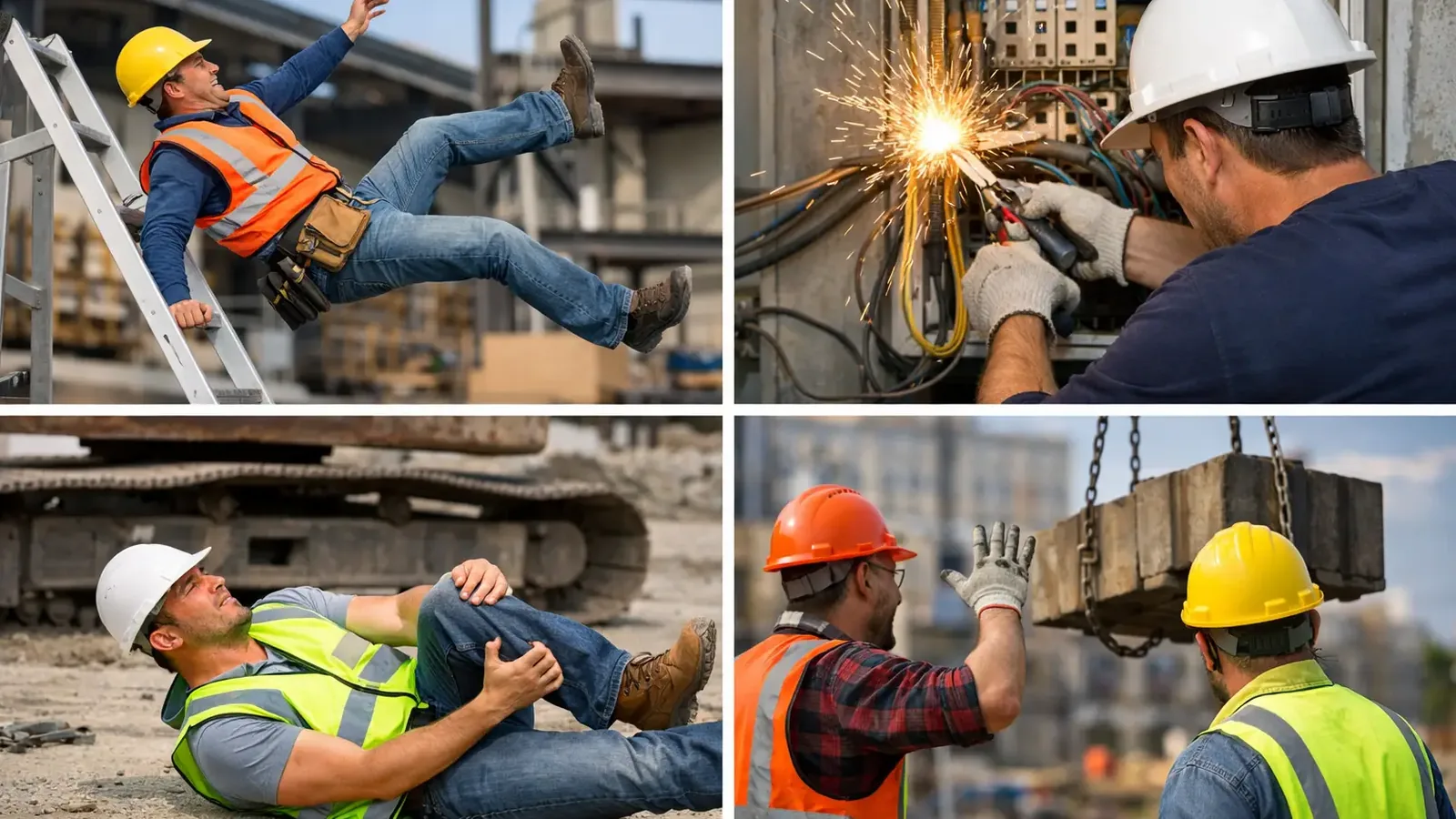
The forklift is backing up, the lift is moving into position, and somebody says the harness is still in the truck. Those are not small misses. They are the kind of ordinary, rushed decisions behind the OSHA Focus Four hazards: falls, struck-by incidents, caught-in or between incidents, and electrocution. These four categories account for a large share of fatal construction injuries because they show up wherever work is moving, lifting, climbing, digging, cutting, or energized.
The Focus Four is often taught in OSHA 10 courses, but a course card does not control a jobsite. The control is the plan, the equipment, the training, and the supervisor who stops work when the plan no longer matches the conditions. A team that knows the four names but keeps working under a suspended load has not solved anything.
What the OSHA Focus Four Hazards Mean on the Job
OSHA uses the Focus Four to concentrate attention on the hazards most likely to kill workers in construction. They are not four separate rules, and they are not limited to large commercial jobs. A two-person roofing contractor, a fabrication company doing field installation, and a warehouse contractor replacing lighting can all face them in one shift.
The categories overlap. A worker can be shocked while using a damaged extension cord from a ladder. A worker can be struck by a loader while trying to stay clear of a trench cave-in. That is why good pre-task planning looks at the work area as a whole, not just the tool in someone’s hand.
Falls: The Hazard People See Coming
Falls are familiar enough that workers can become casual about them. A worker steps onto a top cap, climbs a pallet rack, or unhooks early because the next anchor point is only a few feet away. Then the surface shifts, the ladder kicks out, or the edge is closer than it looked.
In construction, OSHA generally requires fall protection at unprotected sides and edges six feet or more above a lower level under 29 CFR 1926.501. The right method depends on the task. Guardrails can be better than personal fall arrest because they protect the worker without requiring a connection every minute. But guardrails do not fit every roof edge, steel erection task, or lift operation. When a harness and lanyard or self-retracting lifeline are used, the system needs an appropriate anchor, enough clearance below, and a rescue plan.
A harness is not fall protection while it is hanging in the truck. It is also not enough to wear one without knowing where to tie off or whether a swing fall could send the worker into steel, piping, or the side of the building.
Ladders deserve the same attention. Set an extension ladder at roughly a 4-to-1 angle, secure it when possible, and keep three points of contact while climbing. Do not use a ladder as a work platform unless it is designed and set up for that purpose. If the task requires both hands, side loading, or repeated travel with materials, a scaffold or aerial lift may be the safer choice.
Struck-By: Stay Out of the Line of Fire
Struck-by incidents happen when a moving vehicle, swinging load, falling object, or flying material hits a worker. The common factor is exposure to a path that workers did not control.
On a busy site, the danger is often behind the worker. A dump truck backs toward a paver. A telehandler turns with a raised load. A forklift rounds a blind rack aisle. The operator may be trained, but the pedestrian is still betting on being seen. That is a bad plan.
Separate people and equipment whenever the layout allows it. Mark travel lanes, establish exclusion zones, use spotters where visibility is restricted, and make sure the operator and spotter agree on signals before the machine moves. A spotter who is looking at a phone, carrying materials, or standing where the operator cannot see them is not a control.
Loads create a second struck-by problem. Never walk or work beneath a suspended load, even if the lift is taking "just a second." Rigging can fail, a load can shift, or an operator can need to reposition. Workers also need head protection where overhead hazards exist, but a hard hat is the last line of defense, not permission to stand under the load.
Caught-In or Between: The Machine Does Not Get Tired
Caught-in or between incidents include trench cave-ins, workers pulled into moving machinery, and workers crushed between equipment, materials, or fixed objects. These events can happen fast enough that there is no time to pull away.
A trench is the clearest example. Soil does not have to look wet or unstable to collapse. Under OSHA excavation rules, a trench five feet deep or more generally requires a protective system unless it is made entirely of stable rock. Sloping, benching, shoring, and shielding are different methods, and the right one depends on soil, depth, water, nearby loads, and site conditions. A competent person must inspect excavations daily and when conditions change, such as after rain or equipment vibration.
Machine hazards are just as unforgiving. Guards on rotating shafts, belts, pulleys, and points of operation exist because hands, sleeves, gloves, and loose clothing can be drawn into moving parts. Removing a guard to clear a jam is not troubleshooting. It is putting a body part where the machine already proved it can cause trouble.
If a machine must be serviced, cleared, adjusted, or entered where unexpected startup or stored energy could injure someone, use lockout-tagout or the applicable energy-control procedure. Pressing stop is not isolation. Neither is relying on a coworker to stay away from the controls. Verify that energy is isolated before work begins.
Electrocution: Treat Every Source as Live Until Proven Otherwise
Electrical hazards are easy to underestimate because the danger is invisible. A cord looks fine until its damaged insulation contacts metal. A boom gets too close to overhead power. A worker opens a panel believing someone else shut it down.
Start by identifying sources of electrical energy before the task starts: overhead lines, temporary power, buried utilities, panels, generators, cords, and equipment that may become energized by a fault. Keep equipment and materials far enough from overhead lines to prevent contact. Required clearance distances vary by voltage and conditions, so do not guess. If work must occur near lines, the employer needs a qualified plan and coordination with the utility where required.
Use ground-fault circuit interrupters or an assured equipment grounding conductor program for temporary power on construction sites, as applicable. Remove damaged cords, missing ground pins, cracked tool housings, and makeshift connections from service. Do not wrap electrical tape around a problem and call it repaired.
Only qualified workers should perform electrical work that exposes them to electrical hazards. Qualification is task-specific. It involves training, demonstrated skills, knowledge of the equipment, and the ability to recognize the hazard. An OSHA 10 card does not make a worker qualified to troubleshoot energized equipment.
Making Focus Four Controls Work Under Production Pressure
The real test comes when the schedule is behind. That is when workers hear, "Just get up there," "It will only take a minute," or "We have done it this way before." Those phrases should trigger a pause, not faster work.
Before the shift or before a new phase begins, the supervisor should walk through what can move, fall, start, swing, collapse, or energize. Then assign controls that people can actually use. If pedestrians and forklifts share one narrow aisle, telling everyone to be careful is not enough. Change the route, schedule traffic, post a spotter, or block the area while the move happens.
Employers carry the responsibility to provide appropriate training, equipment, inspections, and supervision. Workers still have a duty to follow the plan and speak up when a condition changes. That is not paperwork culture. It is how a team avoids explaining later why someone was under the load, inside the trench, or tied off to an anchor that could not hold.
When the work changes, stop long enough to make the controls match the work. That minute is cheaper than the injury, the investigation, and the empty place on the team.