Blog · Fall protection · 29 CFR 1910.28 · 1926.501
Stop a Fall With the Right Control Before Work at Height Starts
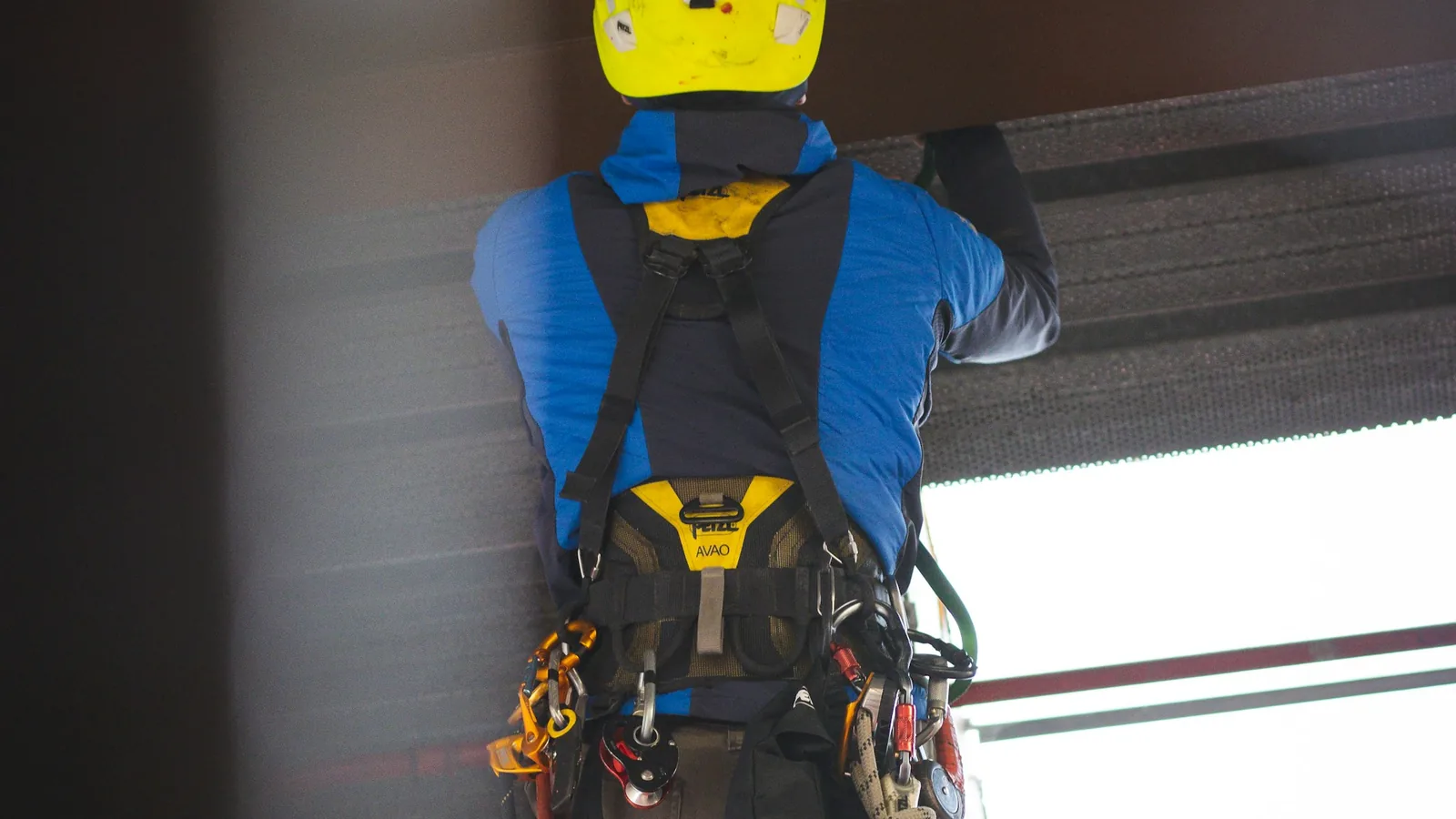
Fall protection works only when the control is in place before the worker reaches the edge. A harness left in a vehicle, a lanyard clipped to steel that was never rated as an anchor, or a guardrail removed for access does not count as protection. A Class 1 self-retracting lifeline tied off overhead reduces free-fall distance, but only as part of a complete, planned system.
Falls happen from roof edges, mezzanines, dock areas, fixed ladders, elevated platforms, aerial lifts, scaffolds, and openings in plant floors. Where a personal fall arrest system is the control, choose a lifeline that fits your fall clearance and the anchor position.
Know the height that triggers fall protection.
The basic OSHA thresholds are easy to state and easy to misuse. In construction, workers generally need fall protection when they are exposed to falls of 6 feet or more. That includes unprotected sides and edges, leading edges, holes, steep roofs, and many other elevated-work conditions covered by OSHA construction standards.
In general industry, the common threshold is 4 feet above a lower level. A worker on an elevated warehouse platform, mezzanine, runway, or walking-working surface can be exposed long before the height feels dramatic. Longshoring has an 8-foot threshold, and scaffolds generally require protection at 10 feet. The exact rule depends on the work and setting, but the practical message is simple: do not use “it’s not that high” as a safety plan.
There are task-specific exceptions and alternative methods in OSHA rules. Roofing, leading-edge work, steel erection, scaffolding, and certain controlled access zones can have different requirements. Those exceptions are not permission for a team to make up its own rules at the edge. They require planning, defined conditions, and employer controls.
Cover holes before a worker steps into one.
Floor openings and skylights get underestimated because they sit flat. A skylight may look like part of the roof, but unless it is protected and rated to hold the required load, it is a fall hazard. Plywood laid over an opening is not automatically a safe cover either.
A proper cover must be secured against displacement and marked so workers know what is under it. A cover that slides when a cart hits it, or gets pulled up by the next trade, creates a trap with a clean-looking surface.
Build a complete system around the harness.
A personal fall arrest system has several parts that must work together: a full-body harness, a connecting device such as a shock-absorbing lanyard or self-retracting lifeline, and a suitable anchorage. If one piece is wrong, the worker is not protected.
The most common mistake is treating any overhead steel, pipe, handrail, or nearby beam as an anchor point. It may not be designed to take fall-arrest loading. Under OSHA’s construction rules, an anchorage used for personal fall arrest must generally support at least 5,000 pounds per attached worker or be designed, installed, and used as part of a complete system under the supervision of a qualified person.
That does not mean workers should guess whether a piece of steel “looks strong enough.” The employer needs to identify approved anchor points before the work starts. If the only available anchor is behind the worker, below the worker, or across a sharp edge, the setup needs another look.
Stop the fall above the level below with enough clearance
A worker can be wearing a harness, tied off, and still strike the lower level during a fall. This happens when the team ignores fall clearance.
A standard shock-absorbing lanyard can allow significant free fall and deceleration distance before it arrests the worker. Add the worker’s body length, harness stretch, connector length, and a safety margin, and a short drop may not provide enough room. A self-retracting lifeline can reduce free-fall distance, but it has its own installation, swing-fall, edge-rating, and compatibility limits.
Before work begins, ask one hard question: if this person falls from this exact spot, where do they stop? If the answer is “probably before the floor,” the plan is not ready.
Remove the exposure with guardrails where they can stay
OSHA’s preferred approach is to control the hazard before relying on personal protective equipment. Guardrails, covers, protected access routes, and work platforms remove or reduce exposure without requiring a worker to connect and disconnect every time they move.
Personal fall arrest is still required where guardrails cannot stay in place. Many tasks require it because guardrails cannot stay in place during the work. But when a team removes a rail to load material, access equipment, or make installation easier, the replacement control must be immediate and real.
A guardrail system also has details. It needs a top rail, midrail or equivalent protection, sound posts and connections, and toe boards where falling-object exposure exists. A sagging chain across an opening may help mark a boundary, but it is not automatically a compliant guardrail.
Match the system to the task.
Fall restraint and fall arrest are not the same thing. Restraint keeps the worker from reaching the edge. Fall arrest lets the worker reach the edge but stops a fall once it begins. Restraint is usually the better choice when it can be set up because there is no arrest force and no suspension rescue problem.
Positioning-device systems support a worker while performing hands-on work, such as certain vertical-surface tasks. They are not automatically fall-arrest systems. A tool belt, body belt, or positioning setup cannot be assumed to protect against a free fall.
Aerial lifts require their own discipline. Workers in boom-supported lifts generally need a personal fall arrest or restraint system attached to the manufacturer-approved anchor point inside the platform. Clipping to a nearby structure so you can lean farther out creates an ejection and swing-fall hazard. Keep both feet on the platform floor. Do not stand on rails, ladders, pallets, or boxes to gain height.
Portable ladders create another judgment call. A ladder is not a work platform, and a harness does not fix poor ladder setup. Set the ladder on a stable base, use the 4-to-1 angle for non-self-supporting ladders, secure it when needed, keep three points of contact while climbing, and do not carry loads that prevent a safe grip. If the task requires both hands, side loading, extended reach, or long-duration work, use a platform or lift instead.
Bring a fallen worker down with a planned rescue.
Workers should inspect harnesses, lanyards, lifelines, hooks, and connectors before use. Look for cuts, burns, chemical damage, broken stitching, distorted hardware, corrosion, missing labels, deployed shock packs, and gates that do not close and lock. Equipment involved in a fall must be removed from service until a competent person determines whether it can be used again.
Fit matters too. A loose harness can cause serious injury in an arrest. Chest straps belong across the mid-chest, leg straps should be snug, and dorsal D-rings belong between the shoulder blades. A worker should not have to borrow a harness that is too large, damaged, or missing parts just because production is waiting.
Teams most often omit the rescue step. A worker hanging after a fall may face suspension trauma and other urgent medical risks. Calling 911 may be necessary, but it is not a complete rescue plan when the site cannot get the worker down promptly. The employer needs a practical method, equipment, trained people, and a clear way to summon help.
Train workers on the system they use
OSHA requires employers to train workers exposed to fall hazards. For construction, the fall-protection training rule is found in 29 CFR 1926.503. General-industry walking-working surface training requirements appear in 29 CFR 1910.30. The training must cover the hazards workers actually face, the systems used at the site, equipment limits, inspection, anchorage, and the correct procedures for the job.
An online course can provide useful awareness. An OSHA 10 card can show that someone completed outreach training. Neither one tells an employer that a worker has been trained on that company’s rooftop anchors, lift model, rescue method, floor openings, or controlled-access plan. Employer-specific instruction and evaluation still matter.
Supervisors need to stop work when the protection is missing, damaged, or incompatible with the task. That can be uncomfortable when a delivery is late, or a shutdown window is closing. It is still cheaper than explaining why somebody was allowed to work at an open edge with “the harness was in the truck.”
Before anyone steps onto an elevated surface, decide at ground level: remove the exposure, guard it, restrain the worker, or use a planned arrest system. If the team cannot explain which one applies and how it works, hold the work.