Blog · Ladders and fall protection
Keep Ladders Away From Power Lines
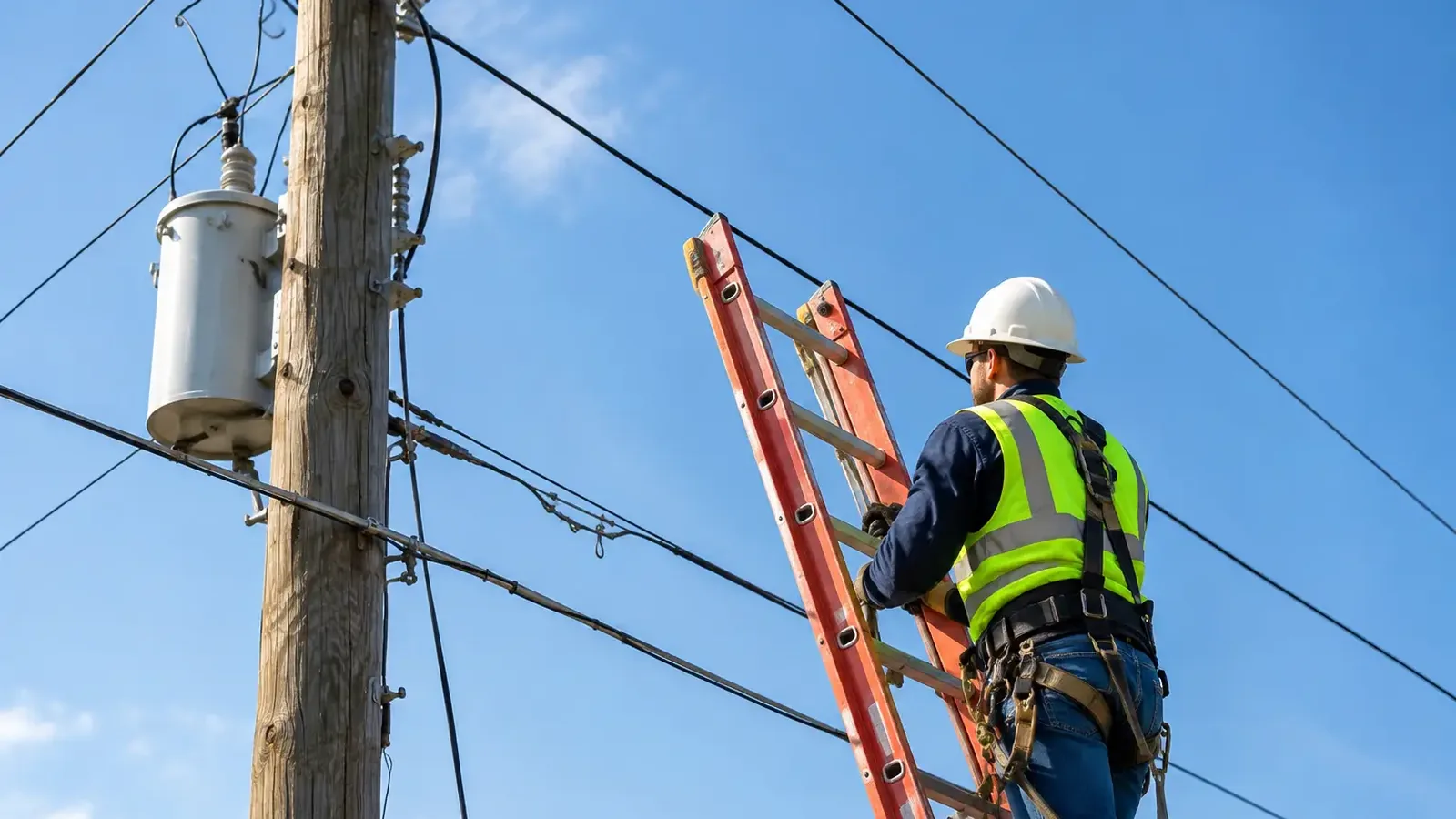
A ladder goes up fast. So can a bad decision. Can ladders touch power lines? No. A ladder, the worker holding it, and the person spotting it all need to stay clear of overhead electrical lines. Treat every line as energized unless the utility owner has confirmed it is de-energized and protected for the work.
That applies to the obvious high-voltage line crossing a jobsite and the service drop running from the pole to a building. It applies when you are cleaning gutters, changing exterior lights, reaching roof edges, setting siding, or grabbing a ladder from the truck. The line does not have to be touched directly for electricity to hurt or kill someone. At higher voltages, electricity can arc through the air.
Can Ladders Touch Power Lines? The Rule on the Ground
The practical rule is simple: keep ladders and people at least 10 feet away from overhead power lines unless the line owner has taken specific protective measures. That 10-foot distance is the basic minimum commonly used around lines energized up to 50 kilovolts. Higher-voltage lines require more clearance.
Do not measure that distance from where the line is sitting when you first look up. Measure for the whole move. An extension ladder can swing sideways, bounce when it is carried, or slide while being raised. Wind can move the line. A worker can lose control of the ladder while trying to clear a corner, roof overhang, or parked equipment.
OSHA’s construction rule at 29 CFR 1926.416 says employees cannot work close to an electric power circuit unless they are protected from electric shock by de-energizing and grounding the circuit, or by effective guarding. In general industry, OSHA electrical-safety rules also require unqualified employees to maintain the required distance from exposed energized parts.
The point is not to win an argument over whether a ladder is technically inside a certain boundary. The point is to prevent an energized line from becoming part of the job.
A Fiberglass Ladder Is Not a Permission Slip
A common shortcut sounds like this: “It’s fiberglass, so we’re good.” No, you are not.
Fiberglass side rails are nonconductive when they are clean, dry, undamaged, and used as intended. But a fiberglass ladder may have metal rungs, fasteners, feet, spreaders, rope, pulleys, or other conductive parts. Dirt, paint, moisture, and jobsite grime can also affect its insulating properties. More importantly, a worker can contact a line, an electrical arc can occur, or the ladder can become part of a path to ground in ways nobody planned.
OSHA requires nonconductive side rails where a worker or the ladder could contact exposed energized electrical equipment. That requirement does not mean a fiberglass ladder may be used under or beside a live overhead line without clearance. It means metal ladders are an even worse choice where electrical contact is possible.
Aluminum ladders and overhead lines are a hard no. Do not carry one upright through an area with lines overhead. Do not raise one near a service drop because “it’s only for a minute.” A minute is long enough.
Wood ladders are not a workaround either. Moisture, contamination, metal hardware, and unknown condition make that a poor gamble around electricity.
Plan the Ladder Move Before It Leaves the Rack
The electrical hazard often shows up before anyone climbs. A two-person team carries an extension ladder upright around a building. One worker watches the ground, the other watches the ladder feet. Neither watches the overhead service line. The upper end drifts into the line.
That is why the ladder plan starts on the ground. Before moving, raising, or repositioning a ladder, look up and identify every overhead line in the work area. Include the route from the storage rack or truck to the setup point. If a line crosses the route, carry the ladder horizontally when practical and use enough people to control it. If you cannot maintain clearance, choose a different route or stop the job.
Once the ladder reaches the work location, set it on firm, level footing. For a non-self-supporting ladder, use the 4-to-1 setup rule: place the base about 1 foot out from the wall for every 4 feet of working length to the support point. A bad ladder angle creates its own fall hazard, and a worker trying to correct a sliding ladder may push it toward an overhead line.
For access to an upper landing, extend the ladder at least 3 feet above the landing surface unless another secure handhold provides equivalent protection. Secure the ladder where possible. Do not “walk” or shift a raised ladder sideways to make it line up. Bring it down, move it, and set it again.
When the Work Is Near a Line, Stop and Change the Plan
Some jobs cannot be made safe by simply picking a fiberglass ladder and being careful. A roof edge directly below a service drop, exterior work beside a pole line, or a tall ladder near utility conductors may require the line owner’s involvement before work begins.
The employer or controlling contractor needs to decide how the hazard will be controlled. That can mean having the utility de-energize and ground the line, installing effective protective guarding through the line owner, relocating the work, or using a different access method from a safe location. Workers should not improvise guards from plywood, pipe insulation, tarps, or a piece of hose. Homemade protection is not electrical protection.
This is also where production pressure causes trouble. Someone says the utility cannot come until tomorrow, the lift is tied up, and the repair “has to get done.” Then somebody brings out the ladder. That is not a field fix. It is a stop-work condition.
A supervisor should be able to answer three questions before authorizing the task: What line is this? What is the required clearance? What control keeps the ladder, worker, tools, and materials outside that boundary? If the answer is “just be careful,” the plan is not ready.
If a Ladder Contacts a Power Line
Do not touch the ladder. Do not touch the worker. Do not grab the line, the building attachment, or nearby metal equipment. A person trying to help can become the next path to ground.
Keep everyone away from the area and call 911 and the utility emergency number. Warn others not to approach. The line may still be energized even if there are no sparks, no noise, and no visible damage.
If a worker is on the ladder, do not yell instructions that cause them to climb down or jump. The safest action depends on exactly what is energized, what the worker is touching, and whether the ladder remains in contact. Keep people clear and wait for trained emergency and utility personnel to control the electrical hazard.
If a line falls to the ground, stay well back. Electricity can energize the soil around the contact point, creating dangerous voltage differences across the ground. Keep vehicles, tools, and bystanders out of the area. Do not assume rubber shoes, dry ground, or a quick step makes it safe.
Training Has to Match the Task
A ladder safety talk should cover overhead lines, not just three points of contact and the 4-to-1 angle. Workers need to recognize service drops, understand why fiberglass is not a free pass, and know when to stop instead of trying to muscle a ladder into position.
A card from an OSHA outreach course can build awareness, but it does not replace employer-provided, job-specific training or supervision. The employer still has to assess the site, provide the right equipment, establish work rules, and make sure workers can apply them under real conditions.
Supervisors set the tone here. If the lead tells workers to keep the ladder 10 feet from every overhead line, checks the route before the carry, and stops the setup when clearance is tight, that rule becomes part of the work. If the lead shrugs and says, “We do this all the time,” workers hear something else.
The ladder is just a tool. The power line does not care how experienced the worker is, how short the task is, or how badly the job needs to be finished. When overhead electricity is in the way, put the ladder down and make the job safe before anyone climbs.