Blog · Fall arrest · 29 CFR 1910.140 · 1926.502
Calculate Fall Clearance for a Self-Retracting Lifeline Before You Tie Off
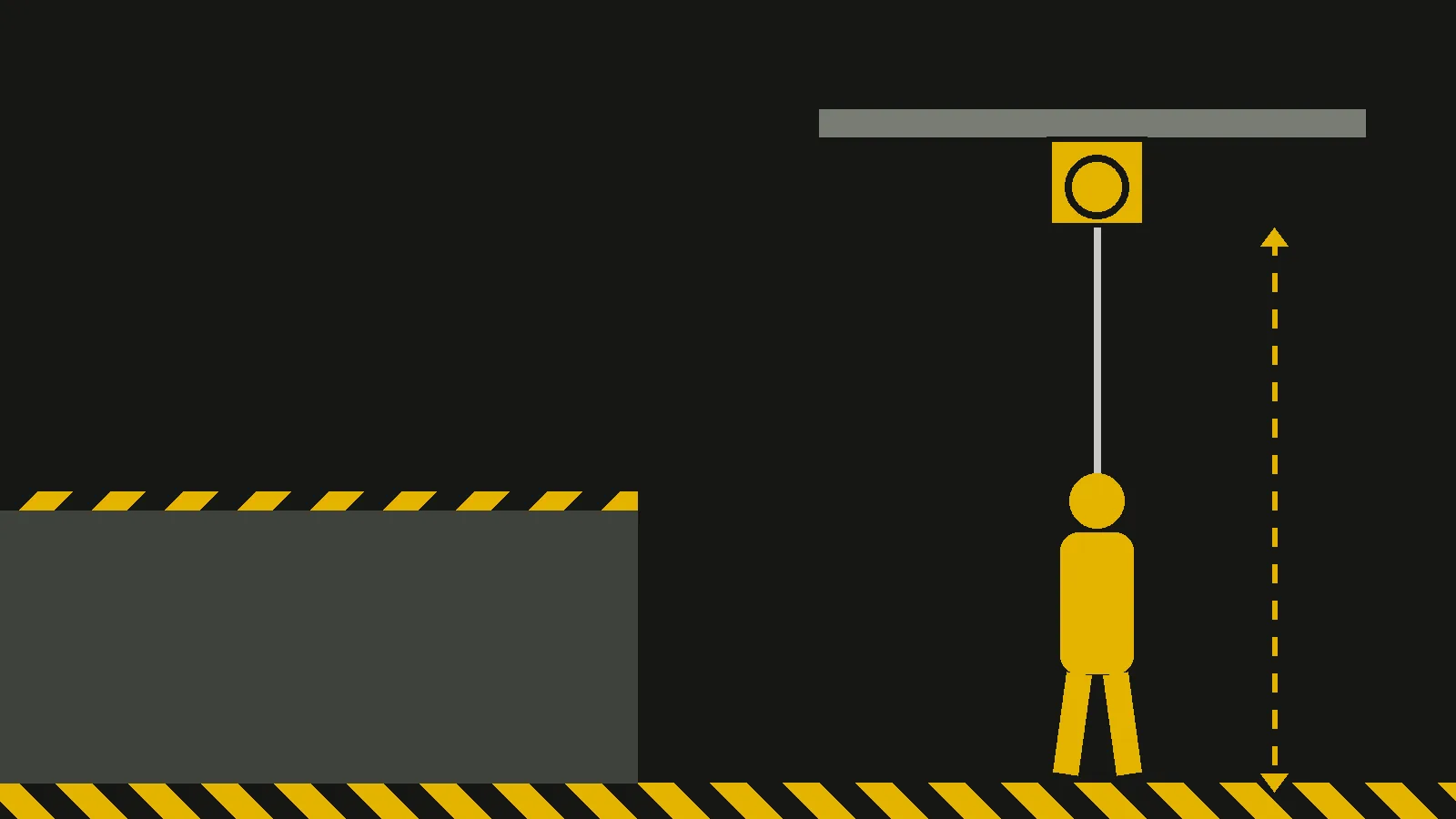
Fall clearance is the space below the work surface that allows a fall arrest system to stop a worker before the worker strikes a lower level. OSHA requires the system to prevent that contact, and the lifeline manufacturer specifies the clearance the product requires. Check both before you compare self-retracting lifelines.
Start with the OSHA limits.
Use these OSHA limits as the baseline when comparing a manufacturer’s stated clearance for a specific self-retracting lifeline.
| Requirement | General industry | Construction |
|---|---|---|
| Free fall no more than 6 ft, and no contact with a lower level | 1910.140(d)(2)(ii) | 1926.502(d)(16)(iii) |
| Deceleration distance no more than 3.5 ft | 1910.140(d)(1)(ii) | 1926.502(d)(16)(iv) |
| Maximum arresting force 1,800 lb with a body harness | 1910.140(d)(1)(i) | 1926.502(d)(16)(ii) |
| Anchorage 5,000 lb per employee, or designed by a qualified person | 1910.140(c)(13) | 1926.502(d)(15) |
1910.140(c)(5) adds that a self-retracting lifeline that automatically limits free fall to 2 ft or less must have components able to sustain at least 3,000 lb with the lifeline fully extended.
Add up the parts of the clearance.
Total clearance is the sum of several distances measured downward from the work surface:
- Free fall. The distance the worker falls before the lifeline locks. With an overhead anchor and a taut lifeline, a self-retracting lifeline keeps this short.
- Deceleration distance. The distance the lifeline pays out while the brake stops the fall. OSHA limits it to 3.5 ft.
- Harness stretch and D-ring shift. The movement of the dorsal D-ring as the harness takes the load.
- Height of the D-ring above the worker’s feet. The body hangs below the D-ring after the arrest.
- Safety margin. Added distance so the feet stop above the obstruction, not on it.
The manufacturer combines these in a clearance chart or a single minimum value for its product. The 3M DBI-SALA Nano-Lok XL listing in the lifeline guide states a required fall clearance as low as 6 ft under its stated conditions.
Read the label and the instructions together.
The lifeline label and the manufacturer’s instructions specify the class, user capacity, the anchor positions the product is rated for, and the required clearance. A lifeline used outside those conditions, such as with a heavier user or an anchor at the feet, no longer meets its published clearance. Keep the instructions with the equipment, and train each user on the product’s chart.
Keep the anchor overhead.
- A Class 1 lifeline under ANSI/ASSP Z359.14 is intended for anchorages at or above the dorsal D-ring.
- An anchor below the D-ring increases free fall and changes the required clearance. Use a lifeline rated for that configuration and consult its own chart.
- Measure clearance from the work surface to the nearest obstruction below, which may be a lower roof, equipment, or a guardrail, not just the ground.
Account for swing fall
When the worker moves sideways away from the anchor, a fall swings the worker back toward a point directly under the anchor. The swing increases the vertical drop and can cause the worker to strike a structure. Keep work within the lateral distance the manufacturer allows, and add the swing to the clearance at the edge of that zone. A longer lifeline covers more area but does not eliminate swing fall.
Check clearance in five steps.
- Identify the anchorage and confirm its strength.
- Measure from the work surface to the nearest obstruction below.
- Read the required clearance from the lifeline manufacturer’s instructions for your anchor position.
- Add a swing fall for work away from the anchor.
- Proceed only if the available distance exceeds the required clearance. Otherwise, use fall restraint or a different system.
Plan rescue before work starts. A worker suspended after an arrest needs prompt help, and 1910.140(c)(21) requires the employer to provide for prompt rescue.