Blog · OSHA training
Is OSHA 10 a License? What the Card Really Means
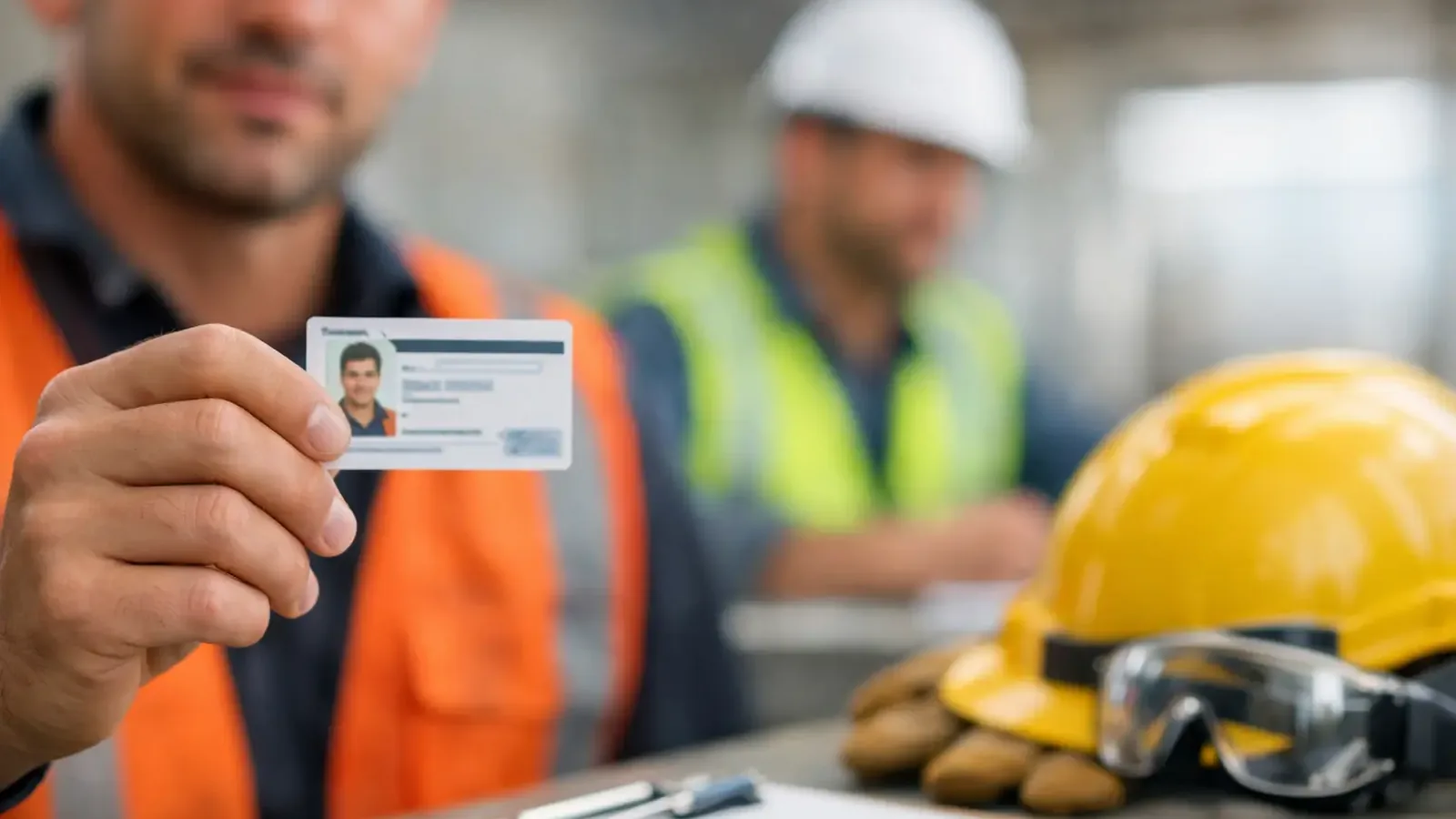
A foreman asks for your OSHA 10 card at the gate. You show it, get cleared onto the job, and start thinking you are licensed for the work ahead. That is where people get hurt by a bad assumption. Is OSHA 10 a license? No. It is an OSHA Outreach Training Program completion card. It shows that you finished an entry-level safety awareness course. It does not authorize you to run equipment, perform a particular trade, enter every jobsite, or skip your employer's training.
That distinction is not paperwork trivia. A wallet card cannot tell whether the disconnect you are about to lock out feeds a second machine. It cannot inspect your fall harness. It cannot evaluate whether you can operate the forklift in your building without clipping a rack or striking a pedestrian.
Is OSHA 10 a license or a certification?
OSHA 10 is neither a professional license nor a job-specific certification. It is commonly called an OSHA 10 certification, and people understand what that means in casual conversation, but the more accurate term is an OSHA 10 Outreach card or course-completion card.
A license is government permission to perform regulated work. Think of a driver's license or a state-issued electrical license. Licenses usually have eligibility rules, testing, renewal requirements, and an agency that can suspend or revoke them. OSHA does not issue an OSHA 10 license.
A certification usually means a person or organization has met defined qualifications and passed an assessment under a certification program. Some occupations and equipment programs use that word in a specific way. OSHA 10 does not certify that you are competent in every hazard covered during the course.
The OSHA Outreach Training Program is designed to give workers a basic safety foundation. The 10-hour course is generally aimed at entry-level workers. OSHA-authorized trainers teach it, and students who successfully complete it receive a Department of Labor Outreach card. The card is real. The training has value. But it is not a universal permission slip.
What the OSHA 10 card actually tells an employer
An OSHA 10 card generally tells an employer that you completed a 10-hour awareness course in either construction or general industry. Those are not interchangeable tracks.
Construction OSHA 10 covers hazards common on active jobsites, such as falls, scaffolds, excavation, electrical work, and struck-by hazards. General Industry OSHA 10 is aimed more at workplaces such as warehouses, plants, fabrication facilities, and manufacturing operations. It may cover walking-working surfaces, machine guarding, hazardous materials, emergency action, and powered industrial trucks at an awareness level.
That foundation matters. A new worker who knows that a six-foot fall exposure needs protection in typical construction work is better positioned to recognize a bad setup. A warehouse employee who understands that forklifts and pedestrians need separation may be less likely to step into a blind corner. Awareness gives people a reason to stop and ask a question before a shortcut becomes an injury.
But the card does not tell an employer whether you understand the specific machine, process, site rules, rescue plan, chemicals, traffic pattern, or energy sources in front of you. Those details are where the real work happens.
What OSHA 10 does not qualify you to do
An OSHA 10 card does not make you a qualified electrician, competent person, forklift operator, rigger, scaffold erector, crane operator, or fall-protection inspector. It also does not replace training required by a particular OSHA standard.
Take forklift operation. A worker may have OSHA 10 General Industry and still have no right to operate the forklift. Under OSHA's powered industrial truck rule, the employer must train and evaluate the operator on the specific type of truck and workplace conditions. The operator must demonstrate safe performance. A card from a general safety course does not show that you can handle a loaded pallet on a ramp, manage a narrow aisle, or work around pedestrians at your facility.
Lockout-tagout is another hard boundary. OSHA 10 may explain why hazardous energy control matters. It does not make an employee authorized to apply locks and tags. Before someone performs servicing or maintenance, the employer must provide the required energy-control training and ensure the worker understands the equipment-specific procedure. “I took OSHA 10” is not an answer when a machine unexpectedly starts.
Fall protection follows the same logic. A course can teach basic principles, but the employer still must train workers for the fall hazards they face. A harness in the truck is not fall protection. Neither is a card in a wallet. Workers need the right anchor point, compatible equipment, inspection practices, a workable rescue plan, and a clear understanding of when to use the system.
Employer training is still the line that matters
The employer has the duty to provide a workplace free from recognized serious hazards and to meet the training requirements that apply to the work. Hiring someone with OSHA 10 can be a smart screening step. Treating that card as a replacement for site-specific instruction is not.
Before assigning hazardous work, a solid employer answers practical questions: What can hurt this worker here? What controls are in place? What must the worker know before starting? Who verifies that the worker can perform the task safely?
For a maintenance technician, that may mean reviewing the written lockout procedure, identifying every energy source, observing a lockout, and documenting authorization. For a new forklift driver, it means formal instruction, hands-on practice, and a performance evaluation. For a roofing contractor, it means jobsite-specific fall-protection training and clear direction on anchors, leading edges, warning lines, and rescue.
The law does not reward an employer for collecting cards while ignoring the job. If the machine is not isolated, the ladder is set on loose scrap, or the operator has never been evaluated, the exposure is still there.
Training must match the task and the worker
A generic video or online module can be useful for basic awareness. It cannot see what the trainee does when a load blocks the view, a coworker removes a lock, or production pressure builds at the end of shift.
Good training includes instruction, but it also includes observation and correction. The supervisor needs to know whether the worker can apply the rule in live conditions. That is especially true for equipment operation, hazardous energy control, confined spaces, fall protection, electrical hazards, and any task where one wrong move carries a high consequence.
Is OSHA 10 required by law?
For most private-sector workers, federal OSHA does not generally require OSHA 10 Outreach training. That surprises people because many contractors, owners, staffing firms, and public projects require it as a condition of working on their site.
Those requirements can be legitimate contract, owner, union, insurer, state, or local rules. Some public construction projects have OSHA 10 requirements written into the bid documents. A company may also require it for all new hires because it establishes a common safety vocabulary.
Still, a customer requirement is not the same thing as an OSHA license requirement. Read the job posting, contract, and site rules carefully. If a job says OSHA 10 is required, ask whether it requires Construction or General Industry. Bringing the wrong card to orientation can delay the job, even though both courses carry the OSHA name.
Does OSHA 10 expire?
The federal OSHA Outreach card does not have a federal expiration date. That does not mean every employer must accept an old card forever.
A site owner, contractor, union agreement, or local rule may require a card issued within the last few years. Employers may also require refresher training when job duties change, new hazards are introduced, procedures change, or a worker shows a gap in understanding. If your card is old, the sensible question is not just whether it is technically valid. Ask whether it is current enough for the work you are being assigned.
Safety knowledge fades when it is not used. So do safe habits when workers normalize shortcuts.
The practical rule for workers and supervisors
Keep your OSHA 10 card. It can help meet hiring and jobsite-entry requirements, and it shows you have completed a recognized safety orientation. Just do not give it powers it does not have.
Workers should ask for task training before taking on work they have not been trained or authorized to perform. Supervisors should verify training and demonstrated ability instead of assuming an outreach card covers the gap. If someone says, “He has OSHA 10, put him on the forklift,” stop the conversation there. The right question is whether the employer has trained, evaluated, and authorized that person for that truck in that workplace.
A card can start a safety conversation. It cannot replace the controls that send everyone home with all ten fingers.